Prophet Elijah pendant charm necklace Medallion orthodox religious jewelry Christmas gift for
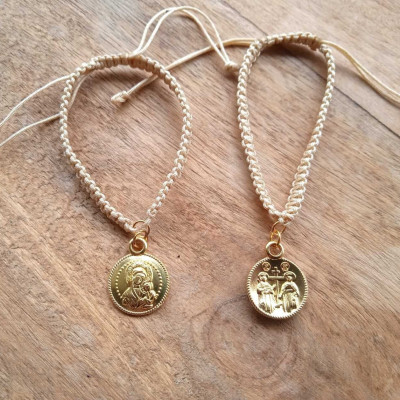
This pendant charm features Prophet Elijah from both sides.
Elijah was, according to the Books of Kings in the Hebrew Bible, a prophet and a miracle worker who lived in the northern kingdom of Israel during the reign of King Ahab (9th century BCE). In 1 Kings 18, Elijah defended the worship of the Hebrew God over that of the Canaanite deity Baal. God also performed many miracles through Elijah, including resurrection, bringing fire down from the sky, and entering heaven alive "by fire". He is also portrayed as leading a school of prophets known as "the sons of the prophets". Following his ascension, Elisha, his disciple and most devoted assistant, took over his role as leader of this school. The Book of Malachi prophesies Elijah's return "before the coming of the great and terrible day of the LORD",[16] making him a harbinger of the Messiah and of the eschaton in various faiths that revere the Hebrew Bible. References to Elijah appear in Sirach, the New Testament, the Mishnah and Talmud, the Quran, the Book of Mormon, the Doctrine and Covenants, and Baháʼí writings.
Elijah's name is invoked at the weekly Havdalah rite that marks the end of Shabbat, and Elijah is invoked in other Jewish customs, among them the Passover Seder and the brit milah (ritual circumcision). He appears in numerous stories and references in the Haggadah and rabbinic literature, including the Babylonian Talmud. According to the Bible, Elijah will return during the End of Times.
The Christian New Testament notes that some people thought that Jesus was, in some sense, Elijah, but it also makes clear that John the Baptist is "the Elijah" who was promised to come in Malachi 3:1; 4:5. According to accounts in all three of the Synoptic Gospels, Elijah appeared with Moses during the Transfiguration of Jesus.
Challenge to Baal
Elijah's offering is consumed by fire from heaven in a stained glass window at St. Matthew's German Evangelical Lutheran Church in Charleston, South Carolina. When Ahab confronts Elijah, he denounces him as being the "troubler of Israel" but Elijah retorts that Ahab himself is the one who troubled Israel by allowing the worship of false gods.
At Elijah's instruction, Ahab summons the people of Israel, 450 prophets of Baal, and 400 prophets of Asherah to Mount Carmel. Elijah then berates the people for their acquiescence in Baal worship: "How long will you go limping with two different opinions? If the LORD is God, follow him; but if Baal, then follow him."
Elijah proposes a direct test of the powers of Baal and Yahweh: he and Baal's prophets will each take one of two bulls, prepare it for sacrifice and lay it on wood, but put no fire to it. The prophets of Baal choose and prepare a bull accordingly. Elijah then invites them to pray for fire to light the sacrifice. They pray from morning to noon without success. Elijah ridicules their efforts. "At noon Elijah mocked them, saying, 'Cry aloud! Surely he is a god; either he is meditating, or he has wandered away, or he is on a journey, or perhaps he is asleep and must be awakened.'" They respond by shouting louder and slashing themselves with swords and spears. They continue praying until evening without success.
Elijah then repairs Yahweh's altar with twelve stones, representing the twelve tribes of Israel. Elijah digs a trench around it and prepares the other bull for sacrifice as before. He then orders that the sacrifice and altar be drenched with water from "four large jars" poured three times, filling also the trench. He asks Yahweh to accept the sacrifice. Fire falls from the sky, consuming the sacrifice, the stones of the altar itself, the earth and the water in the trench as well. When the people see this, they declare, "The LORD— he is God; the LORD— he is God." Elijah then orders them to kill the prophets of Baal, which they do. Then the rains begin, signaling the end of the famine.
Mount Horeb Jezebel, enraged that Elijah had ordered the deaths of Baal's prophets, threatens to kill Elijah. Elijah flees to Beersheba in Judah, continues alone into the wilderness, and finally sits down under a shrub, praying for death. He falls asleep under the tree; the angel of the Lord touches him and tells him to wake up and eat. When he awakens he finds bread and a jar of water. He eats, drinks, and goes back to sleep. The angel comes a second time and tells him to eat and drink because he has a long journey ahead of him.
Elijah travels for forty days and forty nights to Mount Horeb,where Moses had received the Ten Commandments. Elijah is the only person described in the Bible as returning to Horeb, after Moses and his generation had left Horeb several centuries before. He seeks shelter in a cave. Elijah is told to, "Go out and stand on the mountain in the presence of the LORD, for the LORD is about to pass by." There is a powerful wind, an earthquake and fire, but Yahweh is not in any of them. Then a gentle whisper comes to Elijah. Yahweh sends him out again, this time to Damascus to anoint Hazael as king of Aram, Jehu as king of Israel, and Elisha as his replacement.
Vineyard of Naboth Elijah encounters Ahab again in 1 Kings 21, after Ahab has acquired possession of a vineyard by murder. Ahab desires to have the vineyard of Naboth of Jezreel. He offers a better vineyard or a fair price for the land. But Naboth tells Ahab that God has told him not to part with the land. Ahab accepts this answer with sullen bad grace. Jezebel, however, plots a method for acquiring the land. She sends letters, in Ahab's name, to the elders and nobles who lived near Naboth. They are to arrange a feast and invite Naboth. At the feast, false charges of cursing God and Ahab are to be made against him. The plot is carried out and Naboth is stoned to death. When word comes that Naboth is dead, Jezebel tells Ahab to take possession of the vineyard.
God again speaks to Elijah and sends him to confront Ahab with a question and a prophecy: "Have you killed, and also taken possession?" and, "In the place where dogs licked up the blood of Naboth, dogs will also lick up your blood." Ahab begins the confrontation by calling Elijah his enemy. Elijah responds by throwing the charge back at him, telling him that he has made himself the enemy of God by his own actions. Elijah tells Ahab that his entire kingdom will reject his authority; that Jezebel will be eaten by dogs within Jezreel; and that his family will be consumed by dogs as well (if they die in a city) or by birds (if they die in the country). When Ahab hears this he repents to such a degree that God relents in punishing Ahab but will punish Jezebel and their son: Ahaziah.
A midrash tells that they even abolished the sign of the covenant, and the prophet had to appear as Israel's accuser before God
In the same cave where God once appeared to Moses and revealed Himself as gracious and merciful, Elijah was summoned to appear before God. By this summons he perceived that he should have appealed to God's mercy, instead of becoming Israel's accuser. The prophet, however, remained relentless in his zeal and severity, so that God commanded him to appoint his successor.
The vision in which God revealed Himself to Elijah gave him at the same time a picture of the destinies of man, who has to pass through "four worlds." This world was shown to the prophet by God through symbolism: in the form of the wind, since the world disappears as the wind; storm is the day of death, before which man trembles; fire is the judgment in Gehenna; and the stillness is the last day.
Three years after this vision, Elijah was "translated." Concerning the place to which Elijah was transferred, opinions differ among Jews and Christians, but the old view was that Elijah was received among the heavenly inhabitants, where he records the deeds of men.
But as early as the middle of the 2nd century, when the notion of translation to heaven underwent divergent possible interpretations by Christian theologians, the assertion was made that Elijah never entered into heaven proper. In later literature paradise is generally designated as the abode of Elijah, but since the location of paradise is itself uncertain, the last two statements may be identical.
Deliveries - Shipping costs
With love and care we wrap your packages and gift wrap them.
The available shipping methods are as follows:
1. Shipments within Greece with ELTA
Free of charge
Delivery time is about 3-5 business days.
2. Shipments abroad (out of Greece) with ELTA
up to 500gr -> 13€
up to 1k -> 21€
up to 2k -> 29€
Delivery time is about 2-28 business days.
3. Shipments abroad with FEDEX EXPRESS
up to 2k -> 33€
Delivery time is about 2-28 business days.
4. Shipments to the European Union/UK with FEDEX EXPRESS.
up to 1κ -> 27.50€
up to 2κ -> 30€
over than 2k -> 43€
Delivery time is about 2-28 business days.
5. Shipments to the USA are made only with FEDEX EXPRESS.
up to 1κ -> 30€
up to 2κ -> 33€
over than 2k -> 43€
Delivery time is about 2-28 business days.
Notice: For shipments to countries outside the European Union, recipients will be charged the expected customs clearance costs depending on the country of destination.
Product Returns
In case you wish to return a product, please first contact us at monasteryblessing@gmail.com and explain the reasons for your decision. Please do not return products without first contacting us, as they will not be accepted.
Monastery Blessing is not responsible if for reasons of force majeure (e.g. bad weather conditions, strikes, etc.) it is not possible to deliver the products within the specified time.
All the above prices include VAT. Upon completion of your order, an email is automatically sent with the analysis of your order.
Adjustable Silver 925 Ring with Cross Christian Protection Charm orthodox Christian jewelry Christmas gift forThis beautiful Ring charm is Silver 925 ..
Wooden Beaded Prayer Rope Prayer Beads Komboskini car pendant blessed Christmas gift forWooden Christian 33 knot Prayer Rope / Car Pendant / Prayer Be..
Wooden Beaded Bracelet Prayer Rope Komboskini orthodox Rosary Prayer Beads mother's Day Christmas gift for Small Wooden blue Beads Cross bead with ena..
St Archangel Michael the Taxiarch pendant charm Medallion Sterling Silver Gold platedThis beautiful pendant charm is Silver 925 and gold plated, has ..