Menu
Your Cart

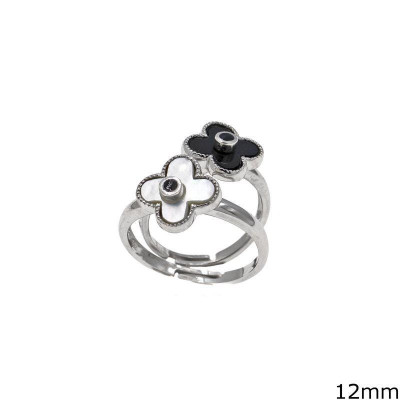
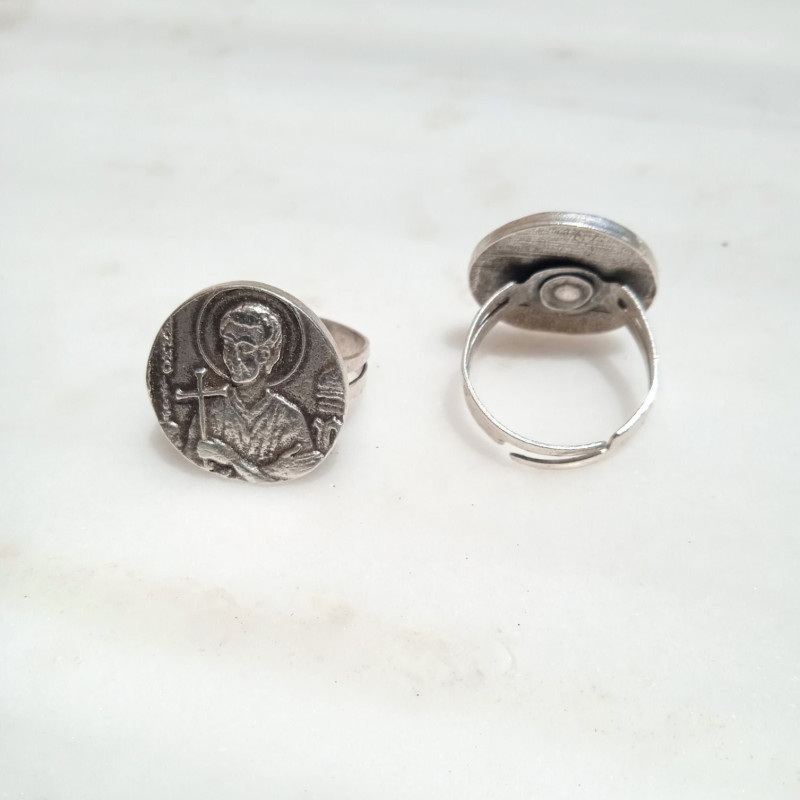
St John the Russian protection ring charm
St John the Russian protection ring charm
  • Stock: In Stock
  • Model: 10145
18.00€
Price: 18.00€

Telephone Order: +30 21 111 5559 / 6976 915563

Gift wrapping available

Specifications

Item Details
Material steel

St John the Russian protection ring charm orthodox christian religious jewelry Christmas gift for

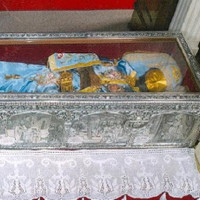
Protect ring with the icon of St John the Russian blessed at his shrine. The ring is steinless steel and it is adjustable with round diameter of the icon 1,8mm

St John the Russian life

Saint John the Russian (Russian: Иоанн Русский) (1690 – May 27 (N.S. June 9), 1730) is one of the most renowned saints in the Christmasn Orthodox Church. Being a prisoner of war and a slave to a Turkish Agha, he became famous and respected even by his Muslim master for his humility, steadiness in faith and benevolence. His holy relics are claimed to be undecayed and wonder-working; there are traditions that this saint particularly helps sick children and those who suffer from cancer.

St. John the Russian was born approximately in 1690 in the Cossack Hetmanate, Russian Tsardom. Having come of age, he was recruited to the army of Peter the Great and took part in the Russo-Turkish War (1710–1711). During the war, he was captured prisoner and sold to slavery to the head of Turkish cavalry.

The saint refused to adopt Islam and was humiliated and tormented for that by the Turks, who called him a kafir, which means "unbeliever". But as the time went by, the mockery had stopped due to saint's steadiness in faith, humility and diligence, and saint John became respected by his master and the household. He worked as a groom and lived in the stables. Other slaves mocked him for the zeal he was working with, but the pious man took no offence, trying to help them in their needs and comforting them when needed. For his sincere kind-heartedness, the saint had earned love and trust of the Agha who proposed him to live as a free man, in separate house. But he refused, saying: "My patron is Lord, and no one is above Him. He predestined me to live as a slave in a foreign land; seems, it must be so for my salvation".

In the daytime John worked and prayed, keeping strict fast, and when the night came, he used to secretly go to the cave-church of St. George, where he said the prayers of All-Night Vigil. Every Saturday he used to take the Holy Communion.

Soon the Agha became rich and one of the most influential people in Urgup. He decided, that it is due to the holy man, who lives in his home. Having become rich, the Agha decided to carry out the Hajj. During this travel, his wife was giving a dinner to the relatives and friends. When the master's favourite dish, pilau was being served, she told John, who was waiting upon the table: "How glad would your master be, if he could eat this pilau with us". The saint asked her to give him this dish, promising to send it to Mecca. Everybody was laughing, but John's request was complied, they decided he wanted to eat pilau himself or give it to the poor.

When the Agha came back, he told about the miracle that had happened to him: while being in Mecca, he found a fuming plate of pilau in his locked room. And on this plate his name was engraved - as on every plate in his home.

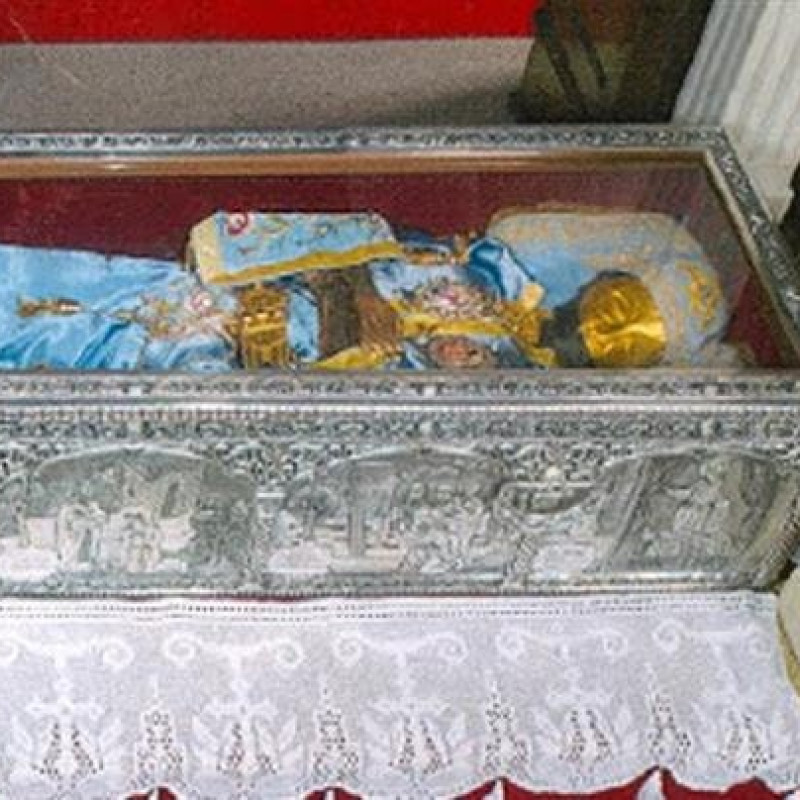
News of this miracle spread quickly, and everyone, even Muslims, began to call John a "Wali" - a "saint". However, he did not change the way he lived, and spent time doing hard work and praying. Before his death, he became seriously ill and, having no ability to stand up, asked for a priest to give him Holy Communion. The priest was afraid to openly go to a Muslim house and hid the Eucharist inside an apple. John the Russian died on June 9, 1730, some time after receiving the Holy Communion. He was buried in the church of St George in Prokopi in Cappadocia (now Ürgüp), and was revered as saint. When the Greeks had to leave Turkey in 1924, the people took his relics to their new home on the island of Euboea.

Write a review

Note: HTML is not translated!
Bad Good
Captcha

Deliveries - Shipping costs

With love and care we wrap your packages and gift wrap them.

The available shipping methods are as follows:


1. Shipments within Greece with ELTA

Free of charge

Delivery time is about 3-5 business days.


2. Shipments abroad (out of Greece) with ELTA

up to 500gr -> 13€
up to 1k -> 21€
up to 2k -> 29€

Delivery time is about 2-28 business days.


3. Shipments abroad with FEDEX EXPRESS

up to 2k -> 33€

Delivery time is about 2-28 business days.


4. Shipments to the European Union/UK with FEDEX EXPRESS.

up to 1κ -> 27.50€
up to 2κ -> 30€
over than 2k -> 43€

Delivery time is about 2-28 business days.


5. Shipments to the USA are made only with FEDEX EXPRESS.

up to 1κ -> 30€
up to 2κ -> 33€
over than 2k -> 43€

Delivery time is about 2-28 business days.


Notice: For shipments to countries outside the European Union, recipients will be charged the expected customs clearance costs depending on the country of destination.


Product Returns

In case you wish to return a product, please first contact us at monasteryblessing@gmail.com and explain the reasons for your decision. Please do not return products without first contacting us, as they will not be accepted.

Monastery Blessing is not responsible if for reasons of force majeure (e.g. bad weather conditions, strikes, etc.) it is not possible to deliver the products within the specified time.

All the above prices include VAT. Upon completion of your order, an email is automatically sent with the analysis of your order.